
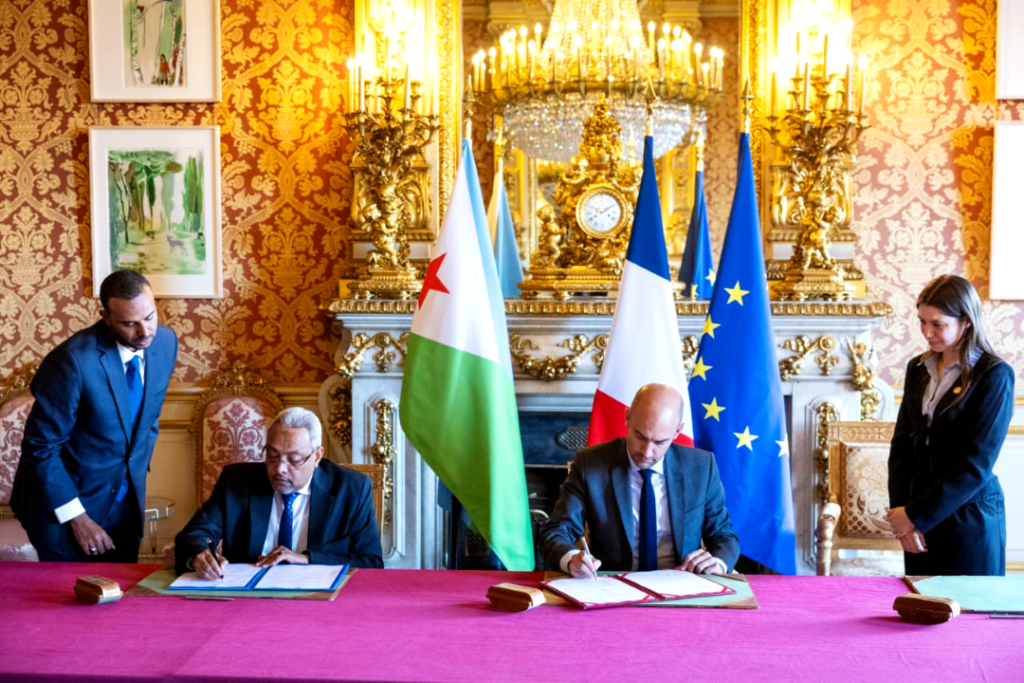
Relations between Djibouti and France are experiencing a new dynamic. On Monday, September 7, at the Quai d’Orsay in Paris, as part of the bilateral political consultations, Djibouti’s Minister of Foreign Affairs and International Cooperation and Government Spokesperson, Abdoulkader Houssein Omar, and his French counterpart, Jean-Noël Barrot, reviewed the main areas of partnership between the two countries. The meeting reflects a shared desire to strengthen a longstanding relationship and adapt it to new strategic, economic and geopolitical realities.
These political consultations are part of efforts to strengthen the historic ties of friendship and strategic partnership between Djibouti and France. The two ministers welcomed the sustained momentum of multisectoral cooperation and reaffirmed their determination to expand its scope into new areas.
Beyond the traditional nature of this relationship, the discussions opened up new prospects in sectors expected to play a decisive role in Djibouti’s development and in strengthening its strategic position in the region.
On the economic front, the discussions focused in particular on revitalizing French investment in Djibouti. The two sides discussed the financing and implementation of priority infrastructure projects, with particular emphasis on the airport sector.
This approach reflects the desire to give new momentum to economic cooperation and encourage the mobilization of new French investments in infrastructure and development. Preparations for the next economic mission of the International Organisation of La Francophonie (OIF) to Djibouti were also among the issues discussed.
Defense and security occupied an important place in the talks.
The two ministers reviewed progress in implementing the new Treaty on Defense Cooperation, considered the cornerstone of the security partnership between the two countries. This cooperation is expected to evolve within a regional environment marked by profound transformations and growing security challenges.
Djibouti, located at the crossroads of several strategic areas, has maintained longstanding defense cooperation with France, with the new treaty now serving as the framework of reference for this partnership.
At the same time, the two sides intend to expand their partnership into areas more directly connected to technological and environmental transformations. Space and research have therefore been identified as new areas of strategic cooperation.
Environmental issues, particularly climate change and its impacts, are also among the sectors expected to receive greater attention. Cooperation between the Interior Ministries of the two countries was also strengthened during the discussions, reflecting the desire to broaden institutional dialogue and enhance exchanges in areas falling within their respective areas of responsibility.
One of the concrete outcomes of the consultations was the signing of an agreement concerning a project to reform secondary education in Djibouti and construct the Balbala multi-purpose secondary school. The agreement gives practical expression to the two countries’ stated desire to strengthen cooperation in education.
Through this project, the bilateral partnership is addressing one of the essential pillars of human development: educating and preparing young people for the demands of the future.
Strengthened Political Dialogue in the Face of Regional Challenges
The political consultations in Paris also provided an important platform for dialogue on major international issues. The two foreign ministers conducted an in-depth review of the regional and international geopolitical situation.
The discussions focused particularly on recent developments in the Horn of Africa, a region at the heart of the strategic interests of both Djibouti and France. Major developments in the Near East and Middle East were also discussed, along with key issues expected to attract attention during the next session of the United Nations General Assembly.
This international dimension reflects the desire of both countries to maintain regular political dialogue on the major crises and transformations affecting their regional environment and the international system.
The regularity of ministerial-level consultations has thus emerged as an essential instrument for deepening coordination, aligning positions where possible, and identifying new areas of cooperation.
In this context, Abdoulkader Houssein Omar invited his French counterpart, Jean-Noël Barrot, to make an official visit to Djibouti on the occasion of the next round of political consultations between the two countries. The visit would provide an opportunity to continue the dialogue initiated in Paris and give fresh momentum to the various issues discussed.
On the sidelines of the consultations, Djibouti’s Foreign Minister also visited the French National Assembly.
He was received at the Palais Bourbon by the President of the National Assembly, Yaël Braun-Pivet. The meeting highlighted the vitality of institutional and parliamentary ties between the two nations.
The President of the France-Djibouti Parliamentary Friendship Group, MP Yannick Favennec-Bécot, as well as the ambassadors of the two countries, Ayeid Mousseid Yahya and Jérôme Bresson, also took part in the meeting.
Thus, from diplomatic exchanges to parliamentary relations, and from defense, the economy, education and the environment to research and new technologies, the Djibouti-France partnership is seeking to enter a new phase.
Ultimately, the regular holding of political consultations confirms the strength of a relationship that is expected to continue evolving. For both Djibouti and France, the challenge now is to transform this historic closeness into increasingly concrete, diversified cooperation adapted to the strategic challenges of the 21st century.