
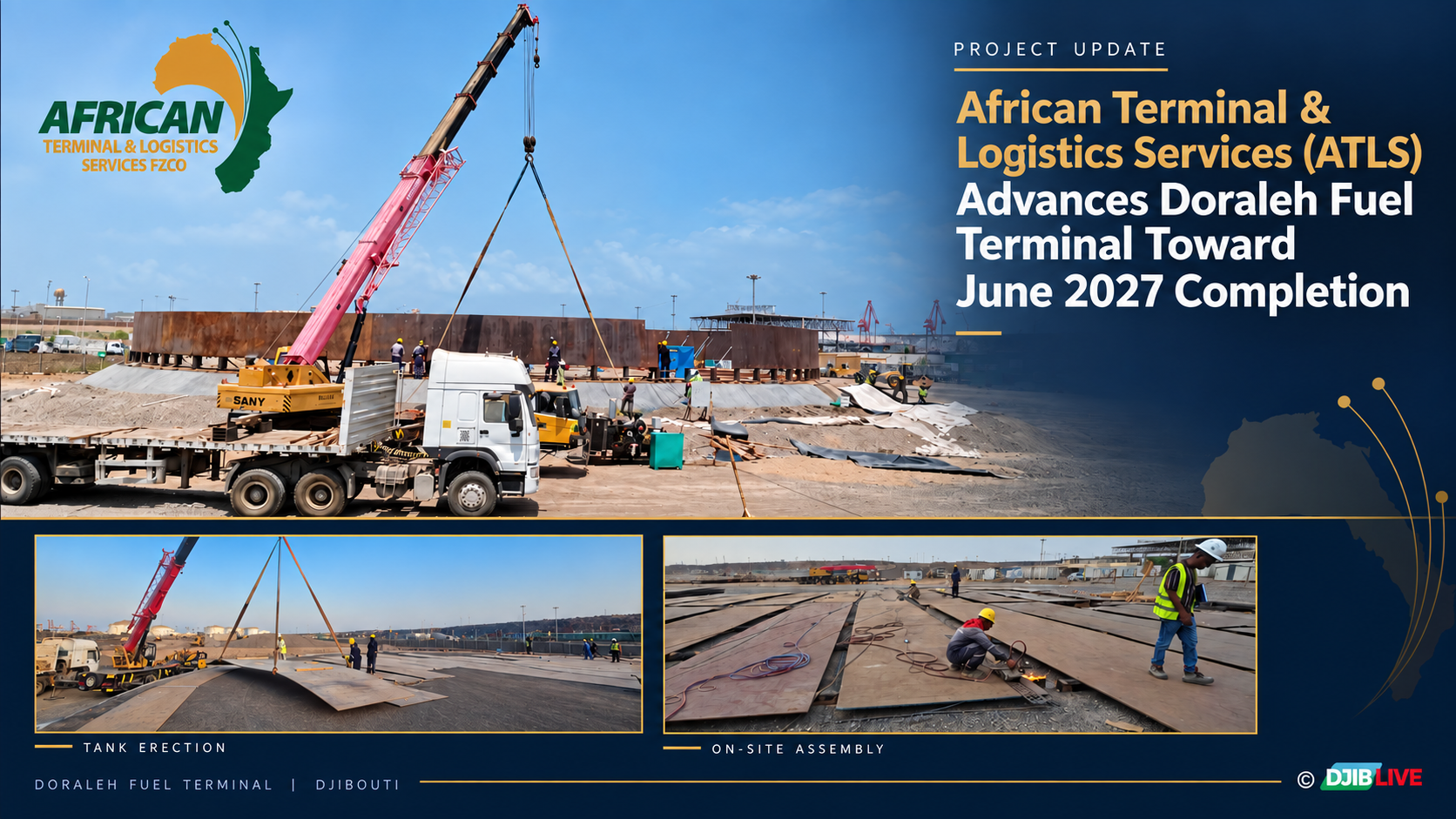
Tank erection is now underway at the fuel and logistics terminal being developed by African Terminal & Logistics Services (ATLS) within Doraleh Multipurpose Port (DMP), with the project on track for completion of Phase 1 in June 2027. The milestone marks a significant step forward in the development of one of East Africa's most strategically positioned energy and logistics infrastructure platforms.
Phase 1 of the project will provide approximately 288,000 cubic metres of storage capacity, with construction and development continuing into Phase 2, which will expand the terminal's capacity to approximately 500,000 cubic metres. Further expansion is planned thereafter, with the overall development offering the potential to reach approximately 788,000 cubic metres of storage capacity.
Developed through a phased three-stage expansion strategy, the project is designed to strengthen fuel security, improve supply chain resilience, enhance corridor efficiency and support long-term trade growth between Djibouti, Ethiopia and the wider East African region.
A key advantage of the project is its location within DMP and its proximity to the Ethio-Djibouti Railway corridor, one of the region's most important logistics arteries, connecting Djibouti's port infrastructure to the Ethiopian market. Unlike conventional storage terminals, ATLS is being developed as an integrated platform — combining marine import infrastructure, high-capacity storage, truck loading operations and rail connectivity within a single corridor solution. This adds meaningful new capacity to the region's energy logistics network while supporting faster and more efficient movement of fuel from vessel to storage and onward into regional markets.
ATLS has placed particular emphasis on both offloading and loading efficiency, with infrastructure designed to maximize throughput and minimize turnaround times across the terminal. Multiple vessel discharge lines will enable rapid transfer of fuel from incoming vessels into storage, reducing vessel turnaround times and supporting efficient marine operations. On the evacuation side, dedicated train loading arms will increase the speed and efficiency of rail loading and the number of wagons loaded daily. A high number of truck loading stations will allow multiple trucks to be loaded simultaneously, maximizing daily truck-loading capacity. Together, these investments are designed to create an efficient end-to-end flow of fuel from vessel discharge through storage and onward by rail or road, maximizing the terminal's overall throughput while reducing potential bottlenecks. This enhanced rail-loading capability will also support continued growth in utilization of the Ethio-Djibouti Railway, complementing the railway's strong recent growth and its increasingly important role in moving fuel and other cargo along the corridor.
The investment case is reinforced by regional fundamentals: the IMF projects Ethiopia's economy will grow 9.2% in 2026, the fastest rate in Sub-Saharan Africa, pointing to sustained long-term demand for energy and logistics infrastructure across the corridor.
The terminal is being built to API 650 engineering and safety standards, reflecting ATLS's commitment to developing a technically robust fuel and logistics platform. ATLS has also invested substantially during the design phase to incorporate stringent safety requirements and ensure full compliance with applicable environmental standards. ATLS is positioning the terminal to serve the growing energy requirements of Ethiopia and the wider East African region for decades to come.